
Grinding mill for calcium carbonate for paint filler in egypt
Introduction: The Egyptian Paint Industry and the Demand for High-Quality Calcium Carbonate
Egypt’s paint and coatings sector has experienced steady growth, driven by a booming construction market and increasing industrial activity. A critical raw material in this industry is calcium carbonate (CaCO₃), used extensively as a functional filler. It improves opacity, brightness, and rheology while reducing production costs. However, the performance of calcium carbonate in paint formulations depends heavily on its particle size distribution, brightness, and consistency. Achieving a superfine product, typically between 325 mesh (45 µm) and 2500 mesh (5 µm), requires advanced grinding technologies. Traditional ball mills or Raymond mills often fall short in energy efficiency, produce inconsistent fineness, or generate excessive iron contamination, which can discolor white paints. This article explores the technical requirements for grinding calcium carbonate for paint filler in Egypt and presents optimized solutions for local producers.
Technical Requirements for Paint-Grade Calcium Carbonate
Paint manufacturers in Egypt demand calcium carbonate that meets strict specifications. The key parameters include:
- Fineness: For interior wall paints, a fineness of 800-1250 mesh is common. For high-gloss or exterior paints, 1500-2500 mesh (d97 ≤ 10 µm or even ≤ 5 µm) is required to ensure a smooth surface and high hiding power.
- Whiteness & Brightness: A whiteness value above 92% (ISO) is essential to maintain the color strength of the paint, especially for white and pastel shades. Iron content must be minimized (Fe₂O₃ < 0.05%) to avoid yellowing.
- Particle Shape: A narrow particle size distribution and a cubic or rounded shape improve packing density and reduce binder demand.
- Consistency: Batch-to-batch consistency in particle size and chemical composition is critical for stable paint production.
These requirements rule out many conventional mills. Jet mills, while capable of ultra-fine grinding, have high energy consumption. Ball mills produce a broad particle distribution and often contaminate the product with iron from the grinding media. This is where the MW Ultrafine Grinding Mill and the LUM Ultrafine Vertical Grinding Mill (discussed below) become the optimal choices for Egyptian producers.

Case Study: Upgrading from a Ball Mill to an Ultrafine Mill for an Egyptian Filler Plant
Consider a calcium carbonate processing plant in the Suez Industrial Zone that supplies filler to a major Cairo-based paint company. Initially, the plant operated two ball mills with classifiers, producing a d90 of 45 µm (325 mesh). The issues were:
- High energy cost: The ball mill system consumed 85 kWh per ton of product.
- Iron contamination: The iron content in the final product reached 0.12%, causing a yellowish tint in white paint base formulations.
- Low hourly output: Each ball mill could only produce 4 tph of the required fineness, requiring multiple units.
The plant replaced one ball mill with a single MW Ultrafine Grinding Mill. The results were transformative. The new mill achieved a d97 of 10 µm (1250 mesh) at a capacity of 8 tph. Energy consumption dropped to 26 kWh per ton. The iron content decreased to below 0.03% because the MW mill has no rolling bearings or screws in the grinding chamber, eliminating a major source of metal-on-metal wear. The return on investment was realized in under 18 months, driven by energy savings and the ability to sell a premium, high-whiteness product.
Recommended Solutions: MW Ultrafine Grinding Mill for Precision & Capacity
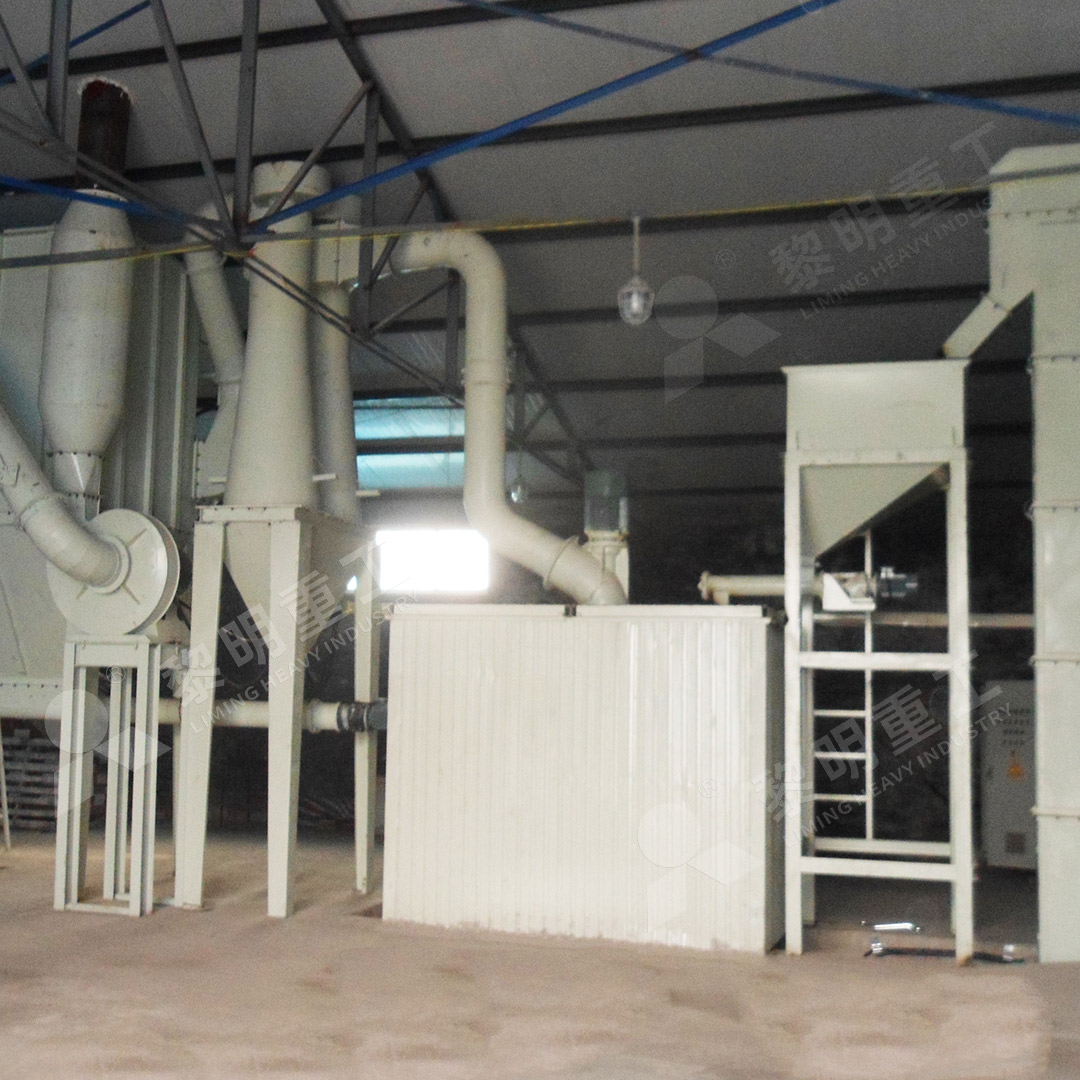
For Egyptian paint filler producers targeting a fineness range of 325 to 2500 mesh (d97 ≤ 5 µm at the finest), we strongly recommend the MW Ultrafine Grinding Mill. This machine is purpose-built for the superfine grinding of non-metallic minerals like calcium carbonate. Its key advantages for the Egyptian market include:
- High Yielding, Low Energy Consumption: The specially designed grinding curves of the roller and ring increase production capacity by 40% compared to jet mills and double the yield of ball mills, while consuming only 30% of the energy of a jet mill.
- Adjustable Fineness: The German-designed cage-type powder selector allows precise adjustment between 325 and 2500 mesh. This flexibility allows a single machine to serve multiple customers with different paint grade requirements, from cheap wall putty to high-end automotive paint.
- No Rolling Bearings or Screws in the Chamber: This unique design eliminates the risk of bearing seal damage or loose screws contaminating the product. The external lubrication system allows 24-hour continuous operation without shutdowns for maintenance.
- Eco-Friendly Operation: The efficient pulse dust collector and silencer ensure the plant meets Egypt’s environmental standards for noise and dust emissions, which is increasingly important for industrial licensing near residential areas.
For operations requiring a higher throughput (5-18 tph) and even greater energy savings in the superfine range, the LUM Ultrafine Vertical Grinding Mill is our second recommendation. The LUM mill integrates grinding, grading, and conveying. Its multi-head powder separation technology, combined with PLC control, allows operators to precisely adjust the cut point for d97 ≤ 5 µm. The double position-limiting technology prevents the roller from directly impacting the millstone, ensuring stable operation even when processing materials with varying hardness.
Operational Considerations for the Egyptian Context
Egyptian processors often face three specific challenges: high ambient temperatures, variable raw material quality (mined marble versus limestone), and the need for quick switching between product grades. The MW Ultrafine Grinding Mill handles these well. The variable frequency drive on the feeder and classifier allows operators to adjust the grind on the fly. The machine’s robust construction, with tens of lines of numerically controlled machining for core parts, ensures long-term reliability despite dusty conditions. Additionally, Liming Heavy Industry provides a sufficient supply of original spare parts through its regional partners, minimizing downtime. Maintenance is straightforward: because there are no screws inside the chamber that can loosen, and the lubrication is external, a single operator can manage the shift.

Cost-Benefit Analysis for an Egyptian Investor
Investing in an MW Ultrafine Grinding Mill for calcium carbonate paint filler grinding is economically sound. Let’s assume a target production of 10,000 tons per year of 1250-mesh filler. Annual energy costs with a traditional ball mill system (80 kWh/t) would be approximately 800,000 kWh. With the MW mill (26 kWh/t), this drops to 260,000 kWh—a saving of 540,000 kWh per year. At an industrial electricity rate of $0.10/kWh, that is $54,000 saved annually. Additionally, the higher purity (lower iron) allows the filler to be sold at a premium of $5-10 per ton in the local market. The total annual revenue uplift can exceed $100,000. Given the machine’s moderate investment cost, the payback period is typically less than two years.
Conclusion
For Egyptian paint filler manufacturers looking to upgrade their grinding capabilities, the choice is clear. The MW Ultrafine Grinding Mill offers a perfect balance of high capacity (0.5-25 tph), ultra-fine fineness (325-2500 mesh), and energy efficiency. It directly addresses the market’s need for high-whiteness, low-iron calcium carbonate. With its robust design, easy maintenance, and compliance with environmental standards, it is a future-proof investment. Whether you are processing local limestone from the Eastern Desert or high-purity marble from Sinai, this mill will deliver the consistent quality that modern paint formulations demand. Contact Liming Heavy Industry for a detailed test grinding of your calcium carbonate sample.

Frequently Asked Questions (FAQ)
- What is the maximum feed size for the MW Ultrafine Grinding Mill?
The maximum input size is 20 mm. Materials larger than this must be crushed by a jaw crusher or hammer crusher before entering the mill. - Can the MW mill produce calcium carbonate powder for both interior and exterior paint?
Yes. The fineness is adjustable between 325 and 2500 mesh by simply changing the rotor speed of the classifier. Interior paint often uses 800-1250 mesh, while exterior or high-gloss paint requires 1500-2500 mesh. - How does the MW mill prevent iron contamination?
The grinding chamber contains no rolling bearings or screws. The roller and ring are made of high-chrome alloy, and the main shaft lubrication is external. This eliminates most sources of metallic wear. - What is the typical power consumption for grinding calcium carbonate to 1250 mesh?
For the MW Ultrafine Grinding Mill, the specific energy consumption is approximately 25-30 kWh per ton, which is about one-third of a jet mill and half of a ball mill system. - Does Liming provide after-sales support in Egypt?
Yes. Liming Heavy Industry has authorized distributors and service centers in Egypt that stock original spare parts (grinding rings, rollers, classifier blades) and offer on-site technical support. - How often do the grinding rollers need replacing?
Service life depends on the abrasiveness of the calcium carbonate. For Egyptian marble with a Mohs hardness of 3, the roller shell life typically ranges from 3000 to 5000 operating hours. - What is the moisture tolerance of the raw material?
The MW mill is suitable for materials with moisture content less than 6%. If the feed is wetter, a hot air system can be integrated for drying during grinding. For standard paint filler, a dry feed (moisture < 2%) is recommended. - Can the same mill grind other materials like talc or barite?
Yes. The MW Ultrafine Grinding Mill is versatile and can process various non-metallic minerals up to Mohs hardness 7, including talc, barite, gypsum, and dolomite. - What is the noise level during operation?
Thanks to the built-in silencer and noise elimination room design, the noise level is below 85 dB(A) at 1 meter distance, making it compliant with Egyptian workplace safety standards. - What is the standard warranty period?
Liming Heavy Industry offers a standard 12-month warranty from the date of commissioning, covering manufacturing defects in core components.